Why China Is Easier Than It Looks
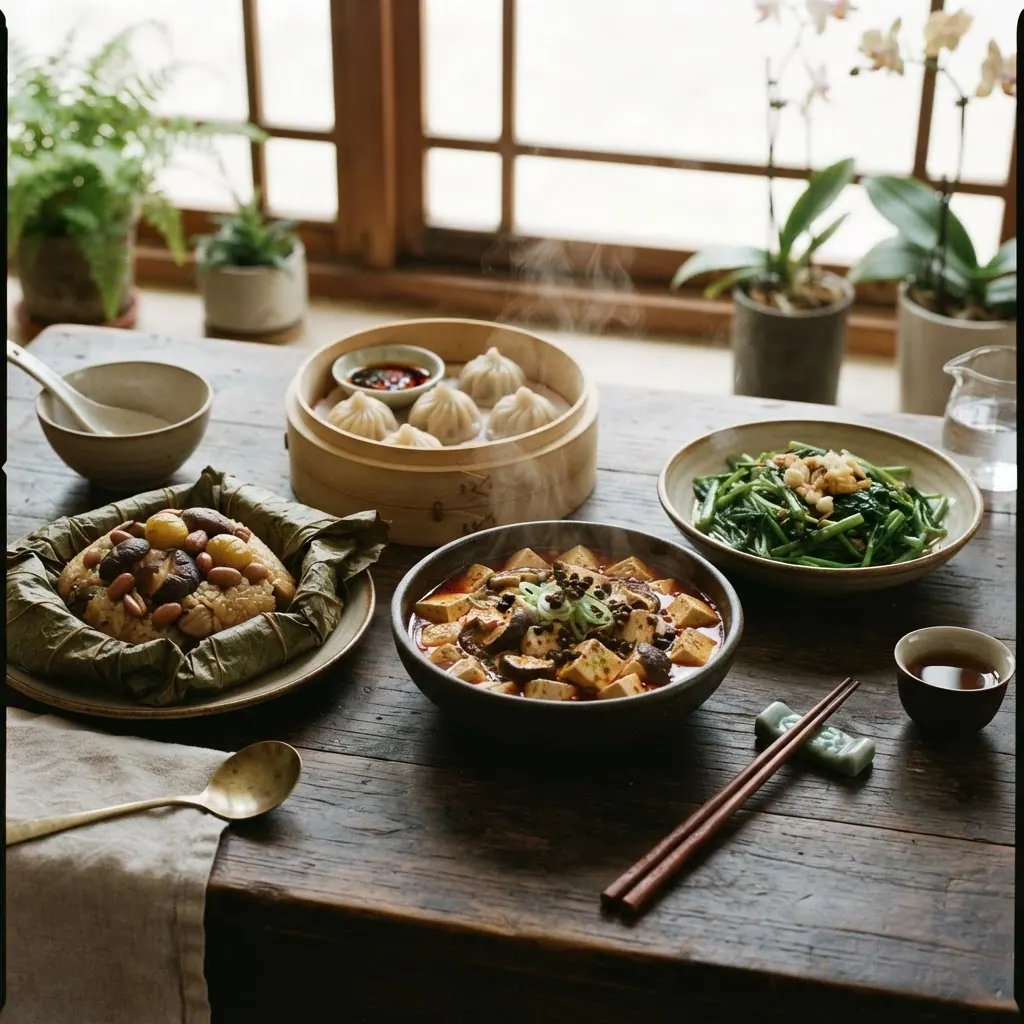
China has one of the world’s oldest vegetarian traditions. Buddhist monastic cooking (sū zhāi, 素斋) developed over centuries, and many cities still have dedicated vegetarian restaurants (素菜馆) that never serve meat. Tofu, wheat gluten, mushrooms, and seasonal vegetables do much of the work — and they do it beautifully.
In practical terms, most Chinese cities have a full vegetarian restaurant within a short taxi ride. And even a tiny neighbourhood kitchen usually knows how to cook vegetables well. The challenge is rarely scarcity; it is communication.
Learn These Phrases Before You Go
A printed card or saved note on your phone solves most problems. Restaurant staff are usually happy to help when your needs are clear. Keep these phrases close:
- 我吃素 (wǒ chī sù) — “I eat vegetarian” — your most important phrase
- 不要肉、鱼、蛋、奶 (bù yào ròu, yú, dàn, nǎi) — “no meat, fish, egg, or dairy”
- 全素 (quán sù) — “entirely vegetarian / vegan” — the strongest guarantee
- 不要鸡精、蛎油 (bù yào jī jīng, háo yóu) — “no chicken powder, no oyster sauce”
- 你们有素食吗? (nǐ men yǒu sù shí ma?) — “Do you have vegetarian food?”
Hidden Ingredients to Watch For
The biggest risk for vegans in China is not obvious meat but “invisible” animal products. Chicken stock or chicken powder is added to vegetable dishes in many restaurants, and oyster sauce appears in stir-fries across Cantonese cuisine. Lard is used in some regional cooking, and fish sauce appears in dishes near Southeast Asian influences.
When ordering, say “quán sù” (fully vegetarian) and explicitly ask for no chicken powder, no oyster sauce, and no meat stock. In vegetarian restaurants this is never an issue; in ordinary restaurants it is worth the extra thirty seconds of communication.
One nuance: strict Buddhist cooks avoid the “five pungent roots” (onion, garlic, and similar), while most Western vegans are fine with them. If you love garlic, ordinary restaurants are actually a better match than temple kitchens.
City-by-City First Impressions
Every major city has a vegetarian scene, but the character differs. Shanghai has the widest range, including modern plant-based cafés and fine dining. Beijing pairs imperial cuisine with a growing number of vegan-friendly restaurants. Chengdu — famous for its spicy food — also has a strong Buddhist vegetarian tradition and some of the most exciting plant-based dishes in the country. Xi’an offers hearty Buddhist cuisine and noodle culture, while Kunming, in Yunnan, is a paradise of wild mushrooms and fresh produce.
Wherever you go, search a map app for “素食” or “素菜馆” and you will find options nearby. A good rule of thumb: if a city has a famous Buddhist temple, it almost certainly has excellent vegetarian food within walking distance.
Temple Food and the Heart of Chinese Vegetarianism
Visiting a temple restaurant is not just about eating — it is a cultural experience. Monastic kitchens transform humble ingredients into dishes that have been refined for centuries, often using wheat gluten and tofu to create remarkable textures. Many temples open their dining halls to visitors, especially around lunchtime.
This is also where you will encounter “mock meat” (仿荤), plant-based dishes shaped and seasoned to resemble meat. In China, mock meat is its own culinary craft. Trying it helps you understand the tradition, even if you never craved the original.
Build Your Trip Around Food Freedom
The simplest way to travel stress-free is to design your journey around food-friendly logistics: stay near neighborhoods with vegetarian restaurants, carry snacks for train days, and book the first night’s dinner before you land. With WeChat translation, a map app, and a few saved phrases, every meal becomes an adventure rather than an obstacle.
And when you want a deeper layer of support, a local vegan travel companion can handle ordering, hidden ingredients, and restaurant discovery for you — so you can spend your energy on the experience itself.